
Acceptance and Commitment Therapy (ACT)
What is Acceptance and Commitment Therapy? A Complete Guide for Patients Exploring ACT Therapy Benefits and Psychological Flexibility
Acceptance and Commitment Therapy (ACT) is a modern psychological intervention that emphasizes psychological flexibility and mindfulness (Hayes et al., 2012). This comprehensive guide will explore the core principles of ACT, its benefits, and how it can help individuals manage various mental health challenges. Many people struggle with anxiety, depression, and emotional dysregulation, often feeling trapped by their thoughts and feelings. ACT offers a unique approach that encourages acceptance of these experiences while committing to personal values and actions. In this article, we will delve into the origins of ACT, its core processes, and how it can be applied to improve mental well-being. We will also discuss the specific benefits of ACT for anxiety and depression, techniques used in therapy, and how to find an ACT therapist near you.
What is Acceptance and Commitment Therapy and How Does It Work?
Acceptance and Commitment Therapy (ACT) is a form of psychotherapy that combines mindfulness strategies with behavioral change techniques. The primary goal of ACT is to enhance psychological flexibility, which allows individuals to adapt to challenging situations while remaining aligned with their values. By focusing on acceptance rather than avoidance, ACT helps individuals develop a healthier relationship with their thoughts and emotions. This approach empowers patients to take meaningful actions in their lives, even in the presence of difficult feelings.
What Are the Origins and Core Philosophy of ACT?
ACT was developed in the 1980s by Steven C. Hayes, Kelly G. Wilson, and Kirk D. Strosahl. The therapy is rooted in relational frame theory, which posits that language and cognition significantly influence human behavior (Hayes, 2004). The core philosophy of ACT emphasizes the importance of accepting thoughts and feelings rather than fighting against them. This acceptance allows individuals to create space for personal growth and change, fostering a more fulfilling life.
How Does ACT Increase Psychological Flexibility?
Psychological flexibility refers to the ability to adapt to situational demands, shift perspective, and maintain focus on personal values. ACT increases psychological flexibility by teaching individuals to observe their thoughts and feelings without judgment. Research has shown that increased psychological flexibility is associated with better mental health outcomes, including reduced symptoms of anxiety and depression (Levin et al., 2012). By practicing mindfulness and acceptance, individuals can learn to respond to their experiences with greater resilience and adaptability.
This understanding is further supported by comprehensive overviews of ACT's foundational concepts (McCracken, 2014).
What Are the Six Core Processes of the ACT Hexaflex Model?
The ACT Hexaflex model outlines six core processes that work together to promote psychological flexibility. These processes include acceptance, cognitive defusion, being present, self-as-context, values, and committed action. Understanding these processes is essential for effectively applying ACT in therapeutic settings.
How Does Acceptance Help in ACT Therapy?
Acceptance in ACT involves embracing thoughts and feelings without attempting to change or control them. This process allows individuals to experience their emotions fully, reducing the struggle against them. Techniques such as mindfulness meditation and experiential exercises are often used to cultivate acceptance, helping patients to acknowledge their feelings without being overwhelmed by them.
What is Cognitive Defusion and How Does It Aid Patients?
Cognitive defusion is a technique used in ACT to help individuals detach from their thoughts. By recognizing that thoughts are merely words and not facts, patients can reduce their impact on behavior. Techniques such as visualization and mindfulness exercises are employed to facilitate cognitive defusion, allowing individuals to observe their thoughts without being controlled by them. This process can lead to improved emotional regulation and a greater sense of agency.
How Can ACT Therapy Benefit Patients with Anxiety and Depression?
ACT has been shown to be effective in treating anxiety and depression by addressing the underlying thought patterns that contribute to these conditions. By fostering acceptance and commitment to values, ACT helps individuals break free from the cycle of avoidance and negative thinking (Ruiz, 2010).
Recent research consistently affirms ACT's efficacy in addressing these common mental health concerns (Beygi, 2023).
How Does ACT Address Anxiety Symptoms Effectively?
ACT addresses anxiety symptoms by encouraging individuals to confront their fears rather than avoid them. Through acceptance and mindfulness practices, patients learn to observe their anxious thoughts without judgment. This approach reduces the power of anxiety and allows them to engage in meaningful activities despite their fears. Research supports the effectiveness of ACT in reducing anxiety symptoms, making it a valuable therapeutic option (Twohig & Hayes, 2017).
What Are the Benefits of ACT for Managing Depression?
ACT offers several benefits for managing depression, including increased psychological flexibility and improved emotional regulation. By focusing on values and committed action, individuals can find purpose and meaning in their lives, even in the face of depressive symptoms. Studies have shown that ACT can lead to significant reductions in depressive symptoms and improved overall well-being (Forman & Herbert, 2009).
What Techniques and Exercises Are Used in ACT Therapy for Emotional Regulation?
ACT employs various techniques and exercises to help individuals develop emotional regulation skills. These practices are designed to enhance mindfulness, acceptance, and commitment to personal values.
Which Mindfulness Practices Support Present Moment Awareness?
Mindfulness practices are central to ACT and help individuals cultivate present moment awareness. Techniques such as mindful breathing, body scans, and guided imagery encourage individuals to focus on their current experiences without judgment. These practices enhance emotional regulation and promote a sense of calm, making it easier to navigate challenging emotions.
How Can Values Clarification and Committed Action Improve Life Quality?
Values clarification is a key component of ACT that helps individuals identify what truly matters to them. By understanding their values, individuals can make committed actions that align with their goals and aspirations. This alignment fosters a sense of purpose and fulfillment, significantly improving overall life quality. Techniques such as values worksheets and goal-setting exercises are often used to facilitate this process.
Who Can Benefit from ACT and How to Find an ACT Therapist Near You?
ACT is suitable for a wide range of individuals, including those struggling with anxiety, depression, emotional dysregulation, and personality disorders. Its flexible approach makes it applicable to various mental health challenges.
What Conditions Does ACT Treat at Contemporary Behavioral Therapy?
At Contemporary Behavioral Therapy, ACT is utilized to treat conditions such as anxiety disorders, mood disorders, emotional dysregulation, and personality disorders. The therapy's focus on acceptance and commitment allows patients to develop healthier coping strategies and improve their overall mental health.
How to Access ACT Therapy Services in Texas and Tennessee?
Individuals interested in ACT therapy can access services at Contemporary Behavioral Therapy, which offers both in-person and virtual sessions. The clinic provides complimentary 30-minute consultations to help individuals explore their needs and determine the best therapeutic fit. Scheduling a consultation is a straightforward process, allowing potential clients to begin their journey toward improved mental health.
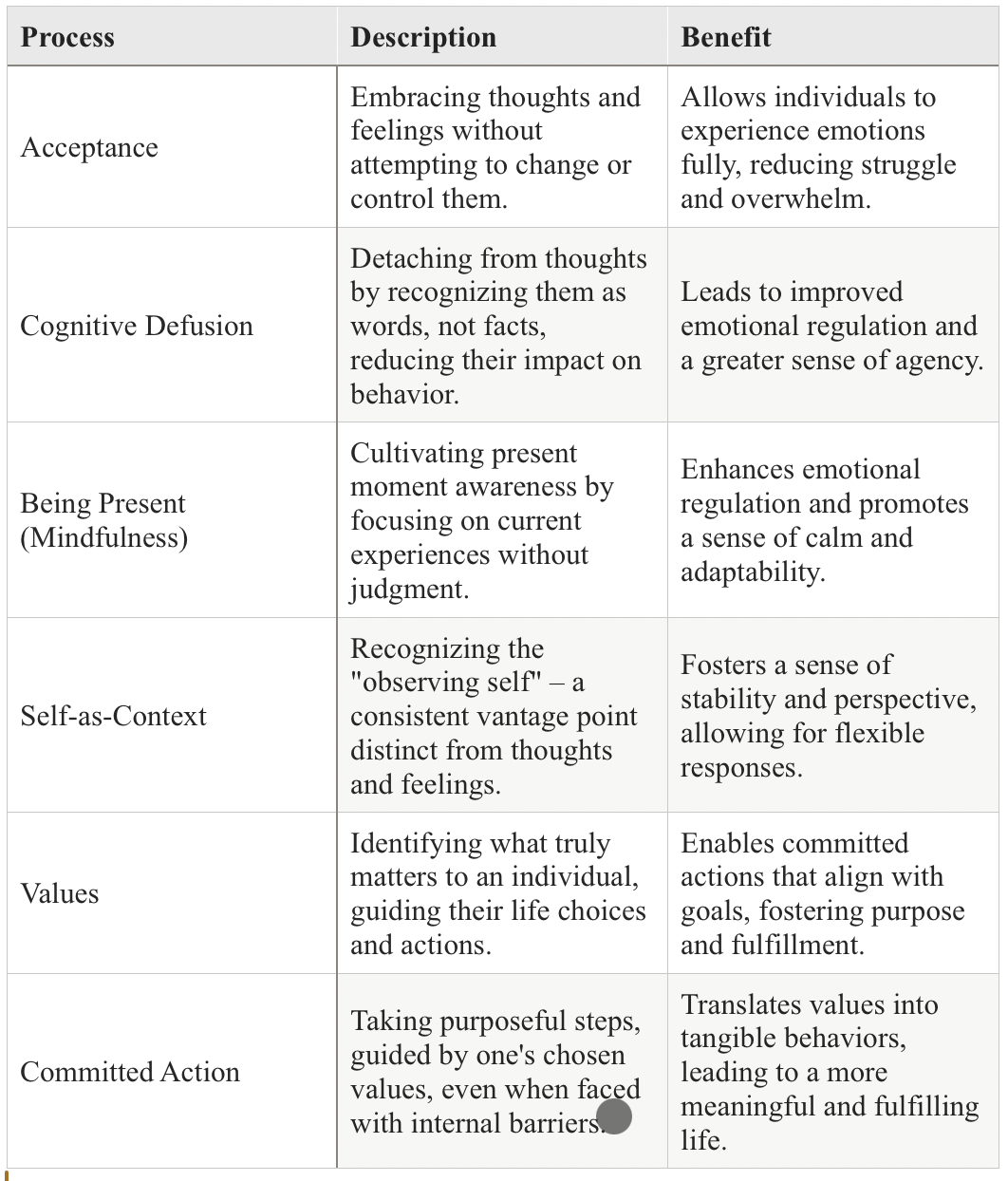
This table summarizes the core processes of the ACT Hexaflex model, highlighting their descriptions and benefits. Understanding these processes is crucial for effectively applying ACT in therapeutic settings.
This table summarizes the core processes of the ACT Hexaflex model, highlighting their descriptions and benefits. Understanding these processes is crucial for effectively applying ACT in therapeutic settings.
ACT offers a unique and effective approach to mental health treatment, emphasizing acceptance, mindfulness, and commitment to personal values. By understanding its core principles and processes, individuals can harness the power of ACT to improve their psychological flexibility and overall well-being.
Ultimately, the profound impact of ACT extends to enhancing psychological flexibility, fostering recovery, and significantly improving overall quality of life for patients (2019).
References
Beygi, Z. (2023). An overview of reviews on the effects of acceptance and commitment therapy (ACT) on depression and anxiety.
Effects of acceptance commitment therapy based recovery enhancement program on psychological flexibility, recovery attitude, and quality of life for inpatients with mental illness. (2019).
Forman, E. M., & Herbert, J. D. (2009). Acceptance and Commitment Therapy for anxiety and depression. In W. O'Donohue & J. E. Fisher (Eds.), *Cognitive behavior therapy: Applying empirically supported techniques in your practice* (2nd ed., pp. 245-256). John Wiley & Sons.
Hayes, S. C. (2004). Acceptance and Commitment Therapy, Relational Frame Theory, and the third wave of behavioral and cognitive therapies. *Behavior Therapy*, *35*(4), 639-665.
Hayes, S. C., Strosahl, K. D., & Wilson, K. G. (2012). *Acceptance and Commitment Therapy: The Process and Practice of Mindful Change* (2nd ed.). Guilford Press.
Levin, M. E., Hildebrandt, M. J., Lillis, J., & Hayes, S. C. (2012). The impact of treatment components suggested by the psychological flexibility model: A meta-analysis of Acceptance and Commitment Therapy. *Behavior Therapy*, *43*(4), 747-765.
McCracken, L. M. (2014). Acceptance and commitment therapy and mindfulness for chronic pain: model, process, and progress.
Ruiz, F. J. (2010). A review of Acceptance and Commitment Therapy (ACT) empirical evidence: Correlational and experimental studies of ACT. *International Journal of Psychology and Psychological Therapy*, *10*(1), 125-162.
Twohig, M. P., & Hayes, S. C. (2017). Acceptance and Commitment Therapy for anxiety disorders: A practitioner's guide to using mindfulness, acceptance, and values-based behavior change strategies. New Harbinger Publications.
These are some helpful ACT oriented reading material for patients and clinicians to include in their library. Click each to see a more detailed description and find a helpful link to purchase.
-
Since the original publication of this seminal work, acceptance and commitment therapy (ACT) has come into its own as a widely practiced approach to helping people change. This book provides the definitive statement of ACT--from conceptual and empirical foundations to clinical techniques--written by its originators. ACT is based on the idea that psychological rigidity is a root cause of a wide range of clinical problems. The authors describe effective, innovative ways to cultivate psychological flexibility by detecting and targeting six key processes: defusion, acceptance, attention to the present moment, self-awareness, values, and committed action. Sample therapeutic exercises and patient-therapist dialogues are integrated throughout.
New to This Edition
*Reflects tremendous advances in ACT clinical applications, theory building, and research.
*Psychological flexibility is now the central organizing focus.
*Expanded coverage of mindfulness, the therapeutic relationship, relational learning, and case formulation.
*Restructured to be more clinician friendly and accessible; focuses on the moment-by-moment process of therapy.Authors: Steven C. Hayes, Kirk D. Stroshl, Kelly G. Wilson.
-
In The Happiness Trap, Dr. Russ Harris provides a means to escape the epidemic of stress, anxiety, and depression, unlocking the secrets to a truly fulfilling life.
Updated and expanded in its second edition, this empowering book presents the insights and techniques of Acceptance and Commitment Therapy (ACT), covering more topics and providing more practical tools than ever before. Learn how to clarify your values, develop self-compassion, and find true satisfaction with this bigger and better guide to:
• Reducing stress and worry
• Handling painful thoughts and feelings more effectively
• Breaking self-defeating habits
• Overcoming insecurity and self-doubt
• Building better relationships
• Improving performance and finding fulfilment at work
The Happiness Trap is for everyone. Whether you’re lacking confidence, facing illness, coping with loss, working in a high-stress job, or suffering from anxiety or depression, this book will show you how to build authentic happiness, from the inside out.Author: Russ Harris